
This weekend was featured a bit of cool relief from the hot, smoky skies of the last few weeks. This weekend we joined up with the BC Employment Standards Coalition (BCESC) and the Vancouver Committee for Domestic Worker and Caregivers Rights (CDWCR) in the park to celebrate and learn at one of their summer tsikahan/chicahan.
We gathered with CDWCR in the park to share food, have informal conversations, and record a structured session on wage theft.
What is wage theft?
Here’s a definition from the BCESC: “Wage theft occurs when employers do not pay us what we are owed under the law. This includes the minimum wages and benefits contained in the Employment Standards Act and the additional benefits and compensation contained in personal contracts of employment or letters of appointment. This happens when we are not paid for all the hours we have worked or are not paid at least the minimum wage. This also happens when we are not paid our full entitlements like overtime, public statutory holiday pay, vacation pay or sick leave pay.
Wage theft also occurs when employers illegally misclassify us as self-employed, independent contractors to try to avoid responsibility for basic workers rights and wages. Employers also avoid responsibility by subcontracting out their work to other companies to insulate themselves from providing proper wages.
Wage theft is widespread because the system is not working to protect our rights. Every year, millions of dollars are stolen from workers and go into the pockets of employers. For example, in 2025 alone the Employment Standards Branch found that complainants were owed $13.7 million in unpaid wages. These corporations get rich by breaking the law while we, as workers (especially migrants, women and racialized people), are left to fight for ourselves. This is not an accident. It happens because our laws are weak and the government that is supposed to enforce the laws is not doing its job.”
5 signs your boss is stealing your wages
#1 You are never given a paystub
You do not know how much you were paid and how much was deducted for taxes.
#2 You have no contact information for your boss
You do not know the company’s name, website, email or office address.
#3 You never signed an employment contract
Or if you did sign one, it is taken away from you, and you are not allowed to keep a copy.
#4 You are paid per hour, but you never have to submit timesheets tracking your hours.
You work hourly but your pay goes up and down, yet you do not know how your employer is counting it.
#5 You are told you are on a “trial shift” and won’t be paid
You are told it is a “trail shift” and won’t be paid for. You are told it is “training” and to see if you are a good fit, but aren’t paid for the hours worked.
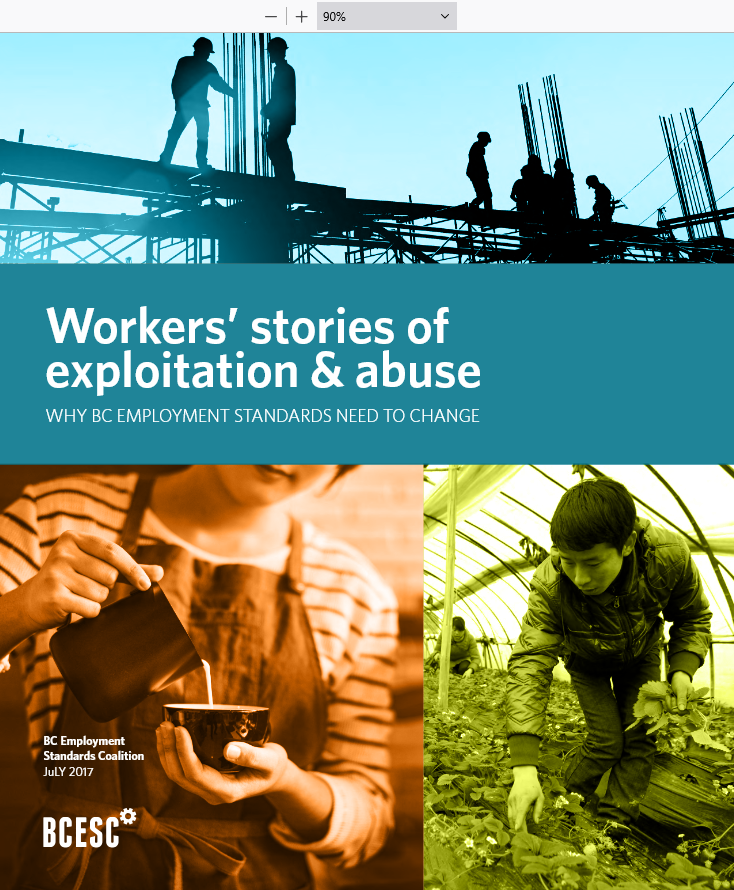
This session was part of a broader campaign the Employment Standards Coalition is working on to support non-unionized and precarious working people in BC. Wage theft is notoriously hard to quantify, as the vast majority of the time it goes unreported. Even when it is reported, and when workers are found to be owed money, that decision can take years. For this campaign, we hope to write and release a report similar to this report that was originally put out by the coalition in 2017.
A recent decision (that’s April 2026) by BC’s Employment Standard Tribunal was found to be in favour of a worker who reported back in 2023 that their employer, Blondie’s Cafe in Sicamous, had not paid them what they were owed and had made improper deductions off their paycheque. Even though the worker was ultimately found to be correct, and the tribunal ordered the employer to repay them what they were owed, they had to wait just about 3 years for the Tribunal to order that Blondie’s pay them their $61.71. Most people aren’t going to suffer the gruelling, and lengthy, process of an employment standards complaint for that amount.
What does wage theft look like?
Any labour lawyer, union representative, or worker advocate will tell you wage theft is rampant in precarious job sectors where there is little regulation or oversight of employers. This is even more true when we look at how migrant workers are treated by their employers. Given their uncertain, and at times, vulnerable, immigration status, employers can feel emboldened to skirt rules and regulations, ask for things they know are illegal, and take advantage of people who may not be aware of their rights.
Top 6 Forms of Wage Theft (from the Worker Solidarity Network)
Forced to pay “employer costs.”
No statutory holiday pay.
Not getting paid for all your work time.
Denied overtime pay.
Last pay cheque is late or missing.
Not getting paid sick days.
Wage theft is a common challenge for migrant care workers. As has been well-documented, migrant care workers are often in uniquely precarious positions due to the intersecting challenges of:
being newcomers to Canada,
relying on their employer for support with their immigration journey,
living with and/or working in the home of their employer,
receiving relatively low wages for their work,
likely having English as a second language,
feeling significant social pressure to agree to employer requests,
and much more.
As part of this session, we split up into three groups, with each having a notetaker and a facilitator to document the experiences and stories of current care workers about wage theft.
Unfortunately, and unsurprisingly, it didn’t take long to start hearing troubling experiences of employer abuse and specific instances of wage theft. In my group, care workers gave stories including the following:
being asked to work on statutory holidays, while being promised addition pay, but ultimately never receiving that pay.
being told that if they break anything in the home while working, they will be expected to pay to replace it out of pocket.
being asked to keep working on a sick day as they “aren’t really that sick”
being asked to take care of the pets in the house when the employer is on an international vacation, but not receiving any payment as they aren’t taking care of the children
Of course, some care workers reported even more significantly horrible treatment, including one worker who explained how she was brought to Canada via a work permit for food service in a fast-food franchise business. She had paid over $12,000 out of pocket to secure this work permit. Once she arrived, her employer immediately moved her to live and work in their daughter-in-law’s house as a nanny and caretaker. She was paid $13, far below minimum wage, in under the table wages. This went on for some time, until she was able to connect with an advocate at CDWCR, who was able to help her take action and escape her situation.
Another care worker talked about how her employer became frustrated with her when she refused to illegally drive the employer’s child around as part of her job. She did not have a Canadian driver’s license, nevermind insurance or other protection should something go wrong. Her employer continued to pressure her and ultimately said she would fire her if she refused to drive the child around.
Another care worker told us that she had been working for her employer for 8 years, but had been told that they would not be renewing her contract as they wished to pay her under the table in cash instead. She asked if this was legal and what she should do. She explained this employer rarely responds to any concerns she raises with them, and does not give her time off or respect statutory holidays.
What can we do about wage theft?
To anyone familiar with migrant care work, this situation is distressing, but unsurprising. Care work is an essential and critical part of our society, and is one of the most significant pillars of our economy. With an ageing population, Canada needs skilled and experienced care workers more than ever.
But tying individual migrant care workers to employers who receive no oversight and have very few consequences for abusing their employees or violating employment standards is setting up a system that is rife for abuse.
Right now, migrant care workers can rely primarily on institutions like the Employment Standards Branch, who are supposed to provide non-unionized workers in British Columbia a mechanism by which to report non-compliant employers and violations of the employment standards act. However, as we know, the ESB has a significant backlog of cases, and it can take years to have a resolution to your case. This is not a realistic solution for most people, especially workers earning minimum or near-minimum wage.
Wage theft is a tricky problem, especially for care workers, as it relies heavily on individual workers speaking up against, and directly to, their employers. This puts them at great risk. Especially for those care workers who live in their employer’s home, they could be risking both where they live and their working income. That’s a lot to risk! For many, the balance simply means they say “yes”, and tolerate what they know to be unfair and often illegal treatment.
In our tsikahan session, care workers explained how they know this to be the case, but still feel they can (and want to) take action. They said they believe that knowing about their rights, connecting with a community of support (like CDWCR), and setting and enforcing boundaries with their employers are all critical elements to protect themselves. One suggested such a strategy as printing out the Employment Standards Act and putting it in a shared space like on the fridge — “we are employer-employee, not family” she said.
But for me, while such courage and self-avocacy is admirable, it is frustrating to see a structural problem like this be downloaded onto the person with the least amount of power in the situation. Ultimately, in my opinion, it shouldn’t be up to the care workers to fight back against illegal behaviour. This is an employer problem, and it should be handled at a higher level. Whenever labour systems rely solely on individual workers speaking up in an unequal power relation against their employer, I think that is a labour system built to disadvantage those workers.
It is not like there aren’t options available to minimize wage theft. While there will always be bad actors in any system, and regulation can never be perfect, any state actor who is allowing Canadian families to employ, and at times house, a migrant worker, should be enforcing a strict system of proactive employer oversight. Written contracts could be mandatory, and submitted to a central portal, with a worker copy required. Paystubs could be required to be uploaded to a central site, with bank account details attached. Home visits and employer-checks could be more frequent and harder to avoid or fool. Closed-work permits, where workers are limited to one specific employer, could be eliminated entirely.
And finally, a solution offered by a care worker, and one that almost all other workers in Canada are entitled to, is that care workers could be allowed to unionize.
Right now, as they work primarily in a one-care-worker-one-employer-family relationship, unionization can feel impossible. But it isn’t. Care workers already do excellent work advocating, supporting, and holding employers accountable through volunteer-run organizations such as CDWCR. They could do so much more with a formal and legal mechanism like that of a trade union.
Organizations like CDWCR have been asking provincial and federal governments for the ability to unionize for decades. CDWCR first submitted a submission to implement a sectoral bargaining systems to the BC Labour Code Review special panel in 1993. While we have not achieved it yet, it is not off our agenda either. Stay tuned for more info on that in future updates.
And now onto ZUMBA

After our discussions, we broke to report back, finish our food and prep for Zumba.
As I approached the snack table, a care worker came over to help point me in the right direction. She took the lid off a large tupperware full of pastries and smiled at me, telling me to eat some. We both pointed at a particularly delicious looking blueberry streudel. She conspiratorially told me that these desserts were donated from a fancy bakery, and that blueberry one was normally $4 — “I can’t even go there!” she laughed.
We both got distracted by the call for the group photo (which we gathered for with great success), but when I returned, I was happy to see the blueberry streudel was gone. I hope she ate it.
-A
