SOME OF OUR RECENT WORK
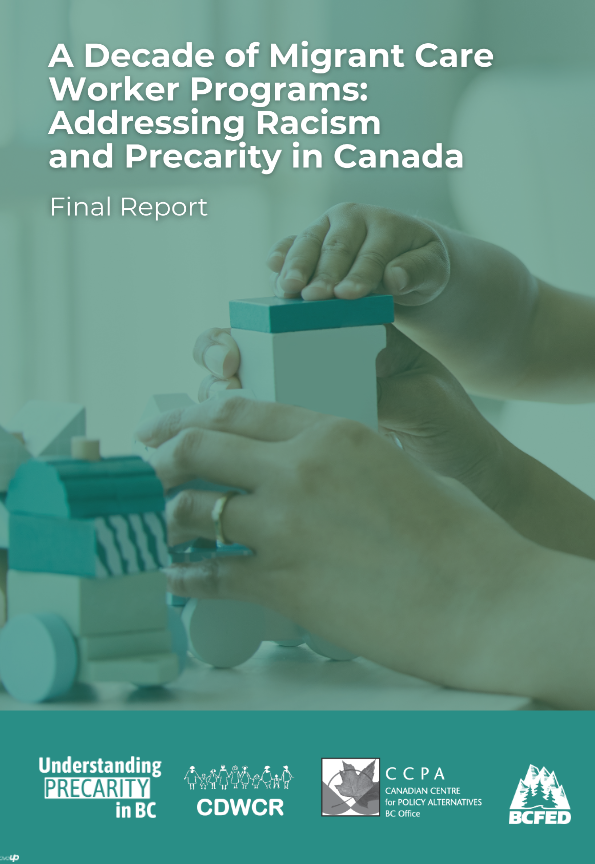
a decade of migrant care worker programs: addressing racism and precarity in canada
For more than a century, Canada has seen thousands of migrant care workers enter the country to provide much needed care work. Since the 1950s, migrant women of colour making a living through care work have often been denied or barriered from accessing clear pathways to permanent residency and navigating exploitative work conditions. In June 2024, Immigration, Refugees and Citizenship Canada (IRCC) announced impending new pilots for migrant care workers. While the announcement brings hope that “new pilot programs will provide home care workers with permanent residence (PR) on arrival in Canada,” we identify persistent problems with Canada’s migrant care worker programs and demonstrate why permanency upon arrival is a requisite for necessary program changes. Given the ongoing and structural issues of Canada’s migrant care worker programs, the newest pilots will also need other critical improvements to ensure dignified work and meaningful inclusion for much-needed care workers in Canada.Our team engaged in mixed-methods research in 2023-2024 to evaluate Canada’s latest iterations of care worker pilots. Our primary focus was the 2014 Caregiver Pilots under the Temporary Foreign Worker Program and the 2019 Home Child Care Provider and Home Support Worker Pilots under the International Mobility Program. Employing methods borrowed from critical discourse analysis, criminology, and investigative journalism (Walby and Luscombe 2020), we examined records obtained from IRCC and interviews with migrant care workers. Our findings reflect ongoing critiques of the care worker programs identified by our research participants, community partners, and even internal IRCC documents. 
Failing to Care for Care Workers: Structural Perspectives on Precarious Employment and Health of Migrant Women Performing In-Home Care Work in CanadA
Anita Minh, Jennifer E. Shaw, Alicia Massie, Alice Mũrage, Ethel Tungohan, Kassandra Cordero, Rincy Calamba, Noemi Rosario Martinez, and Cenen Bagon. In Occupational Health in a New World of Work Pp. 1–18. Springer, Cham. https://link.springer.com/rwe/10.1007/978-3-031-88856-4_27-1.
“When we fight, we win”: migrant domestic worker organizing and engaged intersectional research in Canada
Shaw, J. E., (she/her), Minh, A., (she/her), Massie, A., (she/her), Bagon, C., (she/her), Cordero, K., (she/her, they/them), Mũrage, A., (she/her), … Rosario Martinez, N., (she/her). (2026). “When we fight, we win”: migrant domestic worker organizing and engaged intersectional research in Canada. International Feminist Journal of Politics, 28(1), 202–224. https://doi.org/10.1080/14616742.2025.2610234
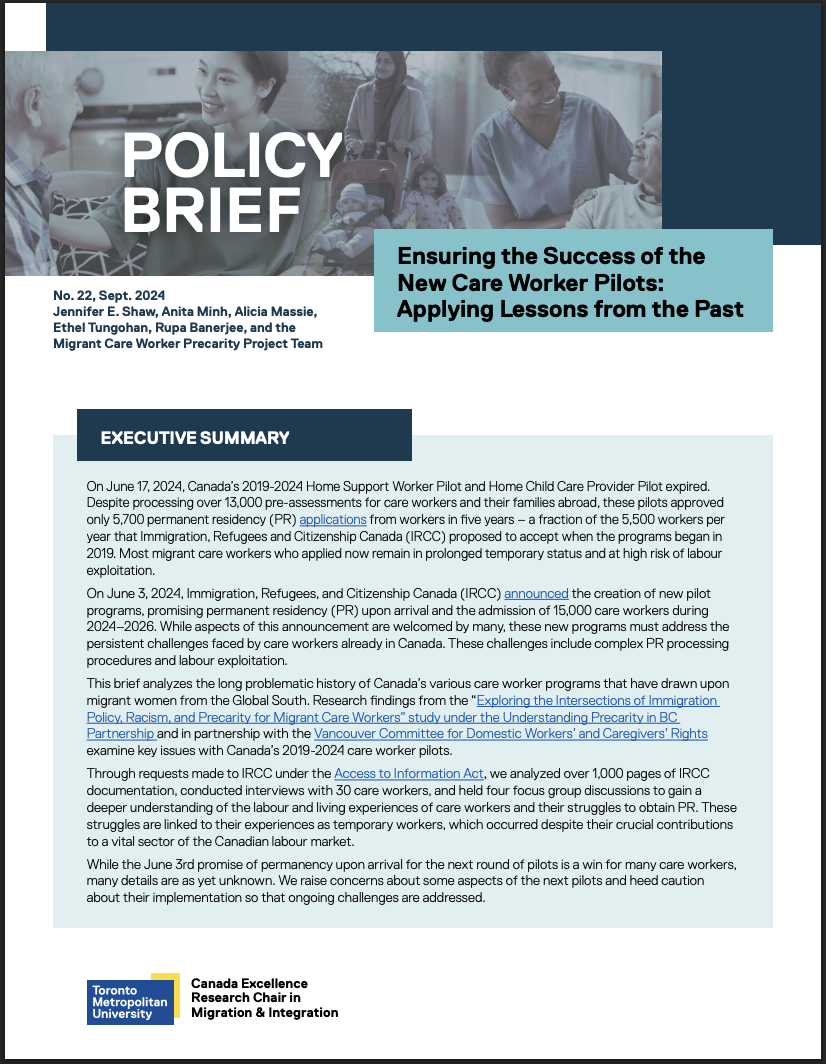
ensuring the success of the new care worker pilots: applying lessons from the past
Jennifer E. Shaw, Anita Minh, Alicia Massie, Ethel Tungohan, Rupa Banerjee, and the Migrant Care Worker Precarity Project Team, The Canada Excellence Research Chair in Migration and Integration (CERC Migration) Policy Brief 22, Toronto Metropolitan University (September 2024)
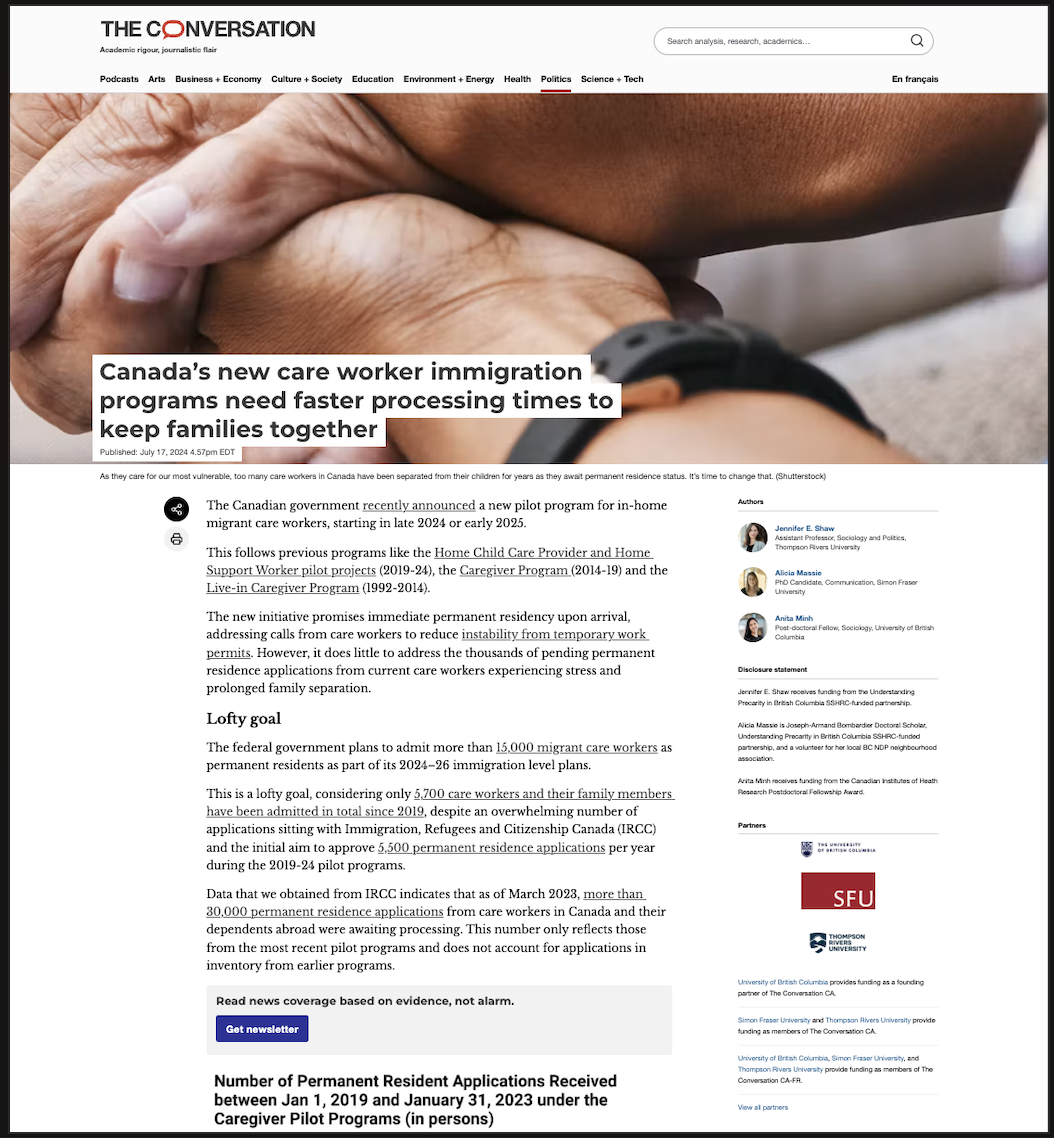
Canada’s new care worker immigration programs need faster processing times to keep families together
Shaw, Jennifer E., Alicia Massie, and Anita Minh 2024 Canada’s New Care Worker Immigration Programs Need Faster Processing Times to Keep Families Together. The Conversation. http://theconversation.com/canadas-new-care-worker-immigration-programs-need-faster-processing-times-to-keep-families-together-234038.
in the media
-
![A woman with shoulder-length brown hair wearing a beige striped shirt, speaking in a video call with a name label showing Jennifer Shaw, researcher at MCWP, with she/her pronouns.]()
North Star Dialogues for change 2026: Confronting migrant injustice in the new era of immigration policy
-
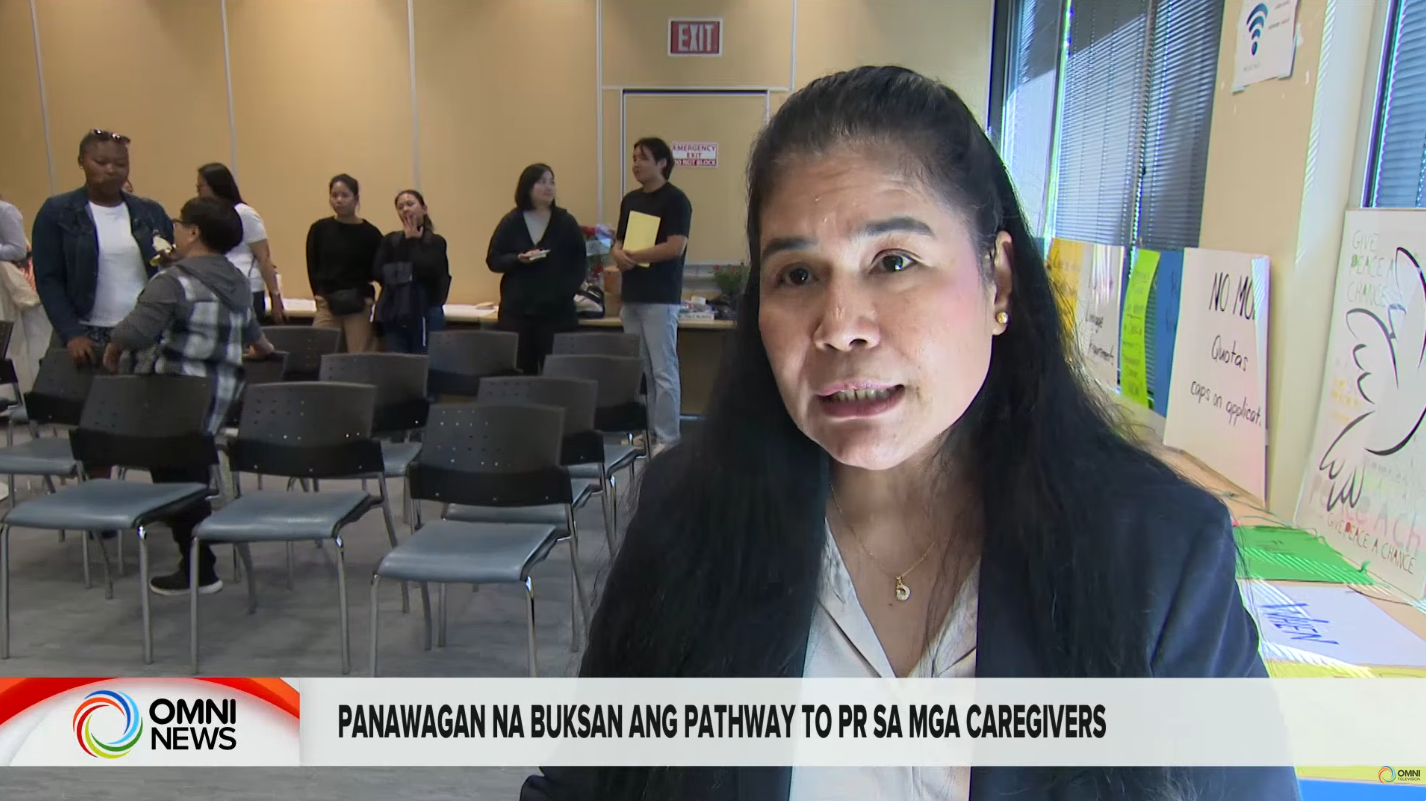
![A woman speaking during a news interview inside a room with chairs and posters on the walls. Several people are in the background, some standing and talking.]()
OMNI: Panawagan na buksan ang PR pathway para sa mga care worker | OMNI News Filipino
-
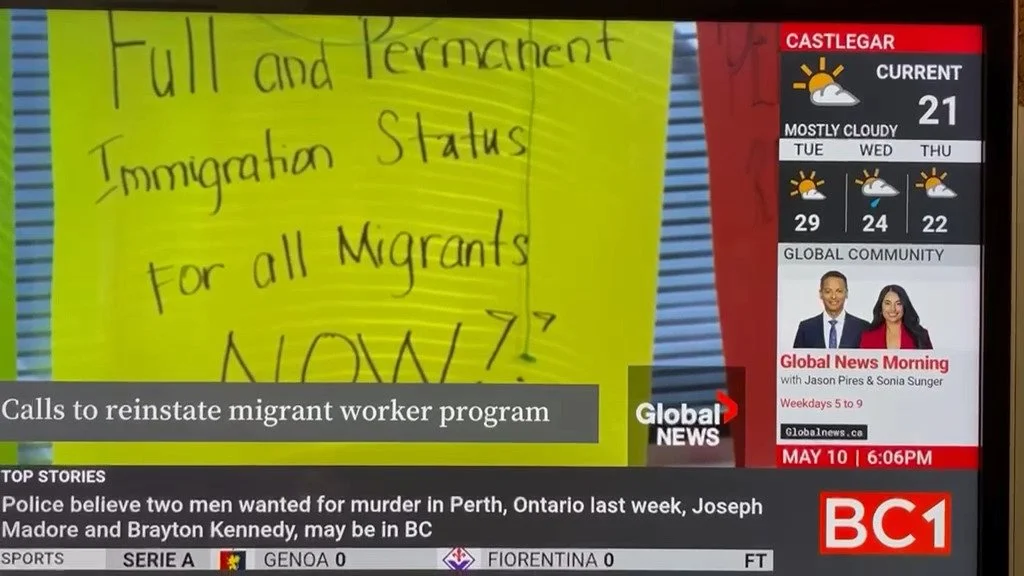
![A yellow sign with handwritten text that reads, 'Full and Permanent Immigration Status for all Migrants NOW?' and a TV news overlay with weather, news, and sports updates, timestamped May 10, 6:06 PM.]()
Global News: Calls to Reinstate Migrant Worker Program
-
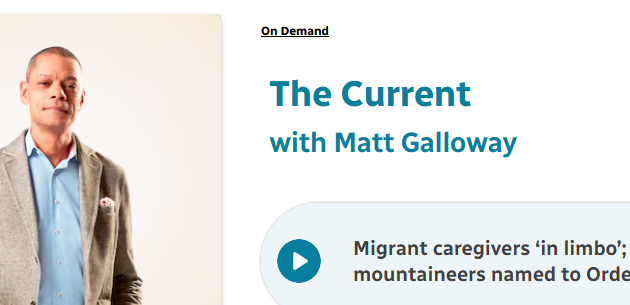
![Image of a man dressed in a light blue shirt and gray blazer, with short hair, standing against a light background.]()
CBC's The Current: Migrant caregivers ‘in limbo’
-
![Radio NL logo with station frequency 610 AM, featuring the words 'Local News Now'.]()
Radio NL 610AM Morning News: Canada’s Broken Promises to Migrant Care Workers
-
![A woman with glasses and a beige jacket smiling and holding a young girl in a red dress, talking to another woman with black hair. In the background, an older woman with glasses and a blue patterned shirt stands near an ice cream counter inside a shopping mall.]()
Caregiver advocates call on Canada to speed up PR Applications | OMNI News Filipino